
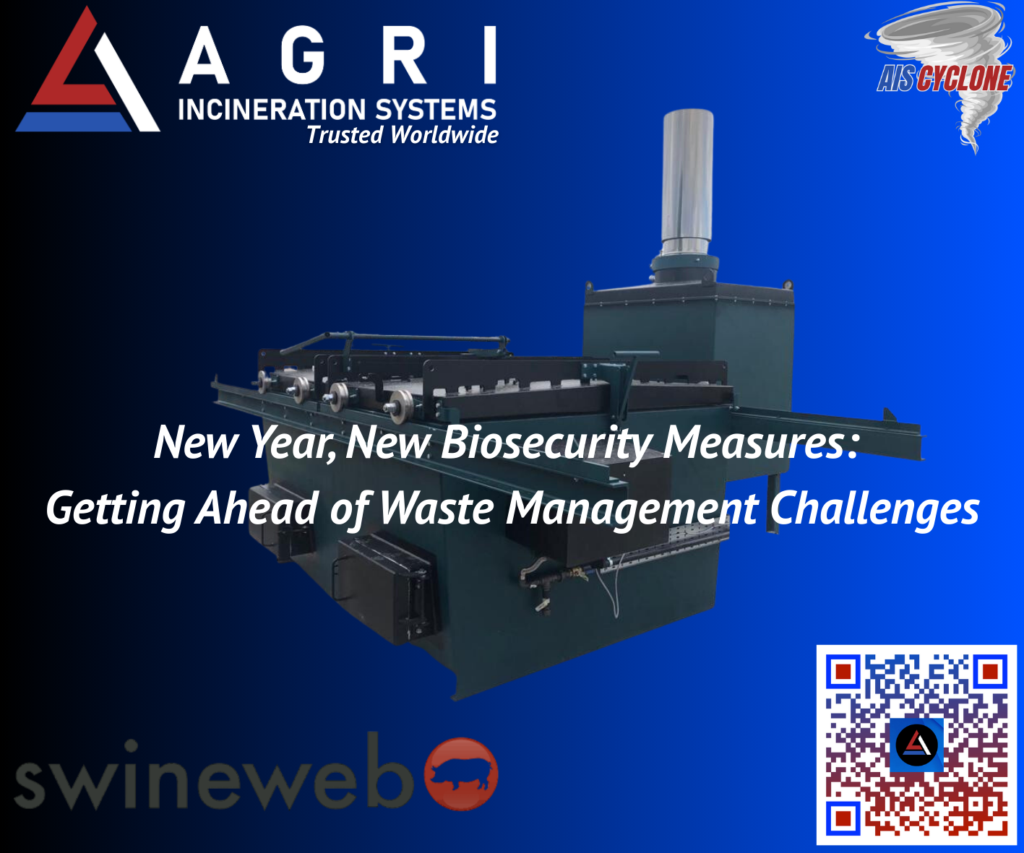
As a new production year begins, swine producers are once again taking stock of their biosecurity programs. Access control, sanitation, and traffic flow are familiar pillars—but waste and mortality management is increasingly where gaps show up. In today’s disease and labor environment, disposal decisions are no longer background tasks; they are frontline biosecurity choices.
Why This Matters Now
The past year reinforced how quickly routine challenges can escalate into operational disruptions. Higher animal densities, ongoing disease pressure, and tighter oversight mean that systems designed years ago may no longer match today’s risk profile. Waste handling—how it’s moved, stored, and disposed of—can either reduce exposure or quietly multiply it.
Waste Management: A Common Weak Link
Carcass disposal and on-farm waste handling can become unintended pathways for disease if not tightly controlled. Each additional step—movement across the site, exposure to wildlife, inconsistent processes—adds risk. Producers are increasingly re-evaluating whether their current approach truly limits pathogen exposure or simply manages volume.
From Management to Prevention
Effective waste disposal isn’t just about compliance; it’s about prevention. A biosecure disposal system helps:
- Reduce pathogen survival and circulation on-farm
- Limit exposure points for employees, visitors, and equipment
- Protect soil, water, and neighboring operations
- Support consistency during peak mortality or labor-constrained periods
As operations scale, repeatability and control matter more than ever.
Incineration Through a Biosecurity Lens
Modern on-farm incineration is drawing renewed attention as a proactive option because it eliminates pathogens at the source rather than relocating risk. High-temperature thermal destruction, enclosed systems, and automated operation reduce variability and exposure—key considerations in a tighter biosecurity environment.
For many producers, the appeal is not novelty but control: fewer handling steps, less movement, and a consistent outcome regardless of season or staffing pressures.
Operational Reality in the Barn
On many farms, waste systems were built for a different era—smaller herds, more labor availability, and lower disease intensity. As production intensifies, solutions that once worked “well enough” are being reassessed. The question is no longer whether a system disposes of waste, but whether it actively reduces risk while fitting modern workflows.
Planning Ahead for the Year
The start of the year is a natural checkpoint to ask:
- Does our current disposal method limit exposure—or create it?
- Can it handle peak mortality without added risk?
- Does it simplify labor or add steps?
- Is it aligned with our long-term biosecurity goals?
The Takeaway
Biosecurity is an integrated system where small decisions have large consequences. Waste management sits at the intersection of herd health, labor efficiency, and environmental responsibility. Producers who treat it as a strategic component—rather than an afterthought—are better positioned to protect herd health and maintain operational continuity.
As the industry looks ahead, the most effective biosecurity programs will be those that close loops, reduce movement, and remove uncertainty—starting with how waste is handled every day.
Learn more: https://agriincinerators.com/
Full Article: https://www.swineweb.com/new-year-new-biosecurity-measures-getting-ahead-of-waste-management-challenges/
See us at these upcoming shows
Iowa Pork Congress 2026
-
January 21–22, 2026 in Des Moines, Iowa at the Iowa Events Center.
International Production & Processing Expo (IPPE) 2026
-
January 27–29, 2026 in Atlanta, Georgia at the Georgia World Congress Center.